Sunday, June 27, 2010

The Merry Wives of Windsor, Cleveland Shakespeare Festival

(Falstaff, Jim McCormack, surrounded by taunting fairies at the conclusion of Merry Wives.)

There could hardly be a more appropriate Shakespeare choice than The Merry Wives of Windsor for the outdoor venues of the Cleveland Shakespeare Festival. Light and frothy, Wives is filled with fanciful seductions and mistaken identities, all ending happily with a suitable moral to boot.

Running in repertory with the dark and violent Titus Andronicus, this play of clever deceits and colliding lovers is a sure balm for a summer evening. And CleveShakes does a handy job with the material, given its budget restraints and tight rehearsal timetable.

Built around the ample framework of Falstaff as a lover of some repute, the play gives all the smarts to the two wives, Mrs. Page and Mrs. Ford, who are pursued by this man of gargantuan appetites. Hip to his come on (duplicate love letters sent to each woman), the gals plan to teach him several humiliating lessons. Meanwhile, three other men are panting after Mrs. Page’s daughter Anne: the French physician Dr. Caius, the gentleman Fenton (an earnest Tyler Babcock) and Slender, the cousin of country pastor Robert Shallow.

Although some character nuances are never really explored, director Tyson Douglas Rand finds many of the broad notes, and plays them with gusto. As Shallow, John Lynch makes his presence known immediately and anchors the opening of the show. Trailing behind, Stuart Hoffman is delightful as Slender, a young man so consumed by love for Mistress Anne he can’t even stand up straight.

As one of Anne’s other paramours, Will Luchin does Dr, Caius as a taller and more macho Inspector Clouseau, wringing every laugh from his butchered accent. At one point, he refers to his competitors by observing: “As they shall be one and two, I shall make a turd.” His act is augmented by Allen Branstein as his servant Jack Rugby, a cowering and most amusing sidekick.

The conniving wives, played by Carli Taylor Miluk and Carrie Williams, plot with gay mischievousness. As Mr. Ford, Aaron Elersich scores as both the cuckold and the disguised Mr. Brook. In the much less juicy part of Mr. Page, Jonathan McCleery handles his duties with panache.

The central role of Falstaff is taken by Jim McCormack, who deftly handles his many lines. But there is a lustiness missing in his character, a sexual vibrancy that would make his repeated comeuppances much more satisfying and entertaining.

The CleveShakes Festival is a lovely free gift to the region, and it can turn an ordinary balmy evening into an unexpected pleasure. So bring a folding chair and check out a performance near (or even far) from you.

The Merry Wives of Windsor

Through August 8, free of charge, produced by

the Cleveland Shakespeare Festival,

at various outdoor locations, check schedule at

cleveshakes.org

Monday, May 10, 2010

Where Are The Reviews?


If you're looking for my reviews, you should check out the weekly pages of Cleveland Scene, plus their Web site: clevescene.com.

Any of my reviews not published in Scene will appear here on my Rave and Pan blog.

As always, thanks for your interest in live theater!

Christine

Wednesday, May 5, 2010

A Midsummer Night’s Dream, Great Lakes Theater Festival

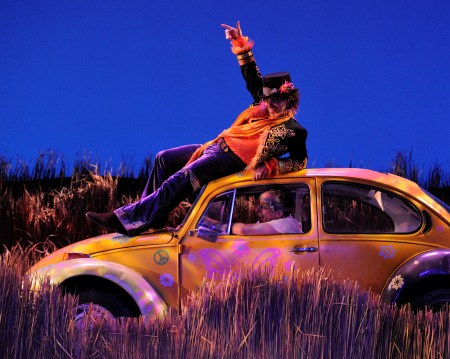
(Eduardo Placer as Puck rides the flowery VW)

For those of us who lived through the 1960s, the decade seems like an ever-appealing amalgam of innocence, drugs, and The Beatles. But for others, it probably just seems like an over-indulged period populated by overly self-centered boomers. That’s why the Great Lakes Theater Festival production of A Midsummer Night’s Dream can feel a bit too familiar and dog-eared.

The problem is not that this company did practically the same show (on the same set) seven years ago, nor is it because the Beatles’ songs don’t fit the dizzy romantic frolics in this light Shakespeare comedy. But once again rolling out the painted VW, the granny glasses and the short skirts just seems a tired attempt at freshening a show that can be plenty zesty all by itself.

Filled with fairies, love potions, and mistakenly mismatched lovers, Midsummer is a lively romp. And some of the right elements are in place here. Kevin Crouch swaggers with attitude as Lysander, who is in love with Hermia (an engaging Gisela Chipe). Dudley Swetland leads his band of rowdy craftsmen with punch and panache, and Aled Davies is just wry enough as Oberon, King of the Fairies.

But there are problems, most of which seem to stem from actors trying too hard to camp it up to please director Charles Fee. The usually reliable David Anthony Smith is an over-the-top caricature of a wacky amateur thespian as Bottom, the weaver who fancies himself a prodigious acting talent. And Eduardo Placer works his role as Puck so hard, channeling the intensity of Jim Morrison into this quick-witted elf, that he turns Puck into more of an OCD drone than an amusing and fun-filled sprite.

Meanwhile, Lina Chambers as Helena and Dane Agostinis as Demetrius never register sharp characters, floating through their scenes rather anonymously.

Even so, this play has suffered worse treatments and emerged victorious, and it does so here. Once the mechanicals take the stage in Act Two and present their play within a play, one can look past the Sgt. Pepper band outfits (yawn) and enjoy the evergreen genius of Shakespeare’s inspired discourse on love and magic.

A Midsummer Night’s Dream

Through May 15 at the Great Lakes

Theater Festival, Hanna Theater,

2067 E. 14th Street, 216-241-6000

Friday, April 23, 2010

A Soldier’s Tale, Cleveland Play House

(Robert Ellis, center, as the General)

Sometimes, a hearty stew tastes like mush because all the individual flavors have melded together into one incomprehensible blob. Then again, there's zesty fare like A Soldier’s Tale, now part of Fusion Fest at the Cleveland Play House.

Employing a challenging and intriguing composition by Igor Stravinsky, based on a Russian folk tale, a septet from the Cleveland Orchestra conducted by Tito Munoz sets the musical stage. Then, four actors share the Baxter Theater space with dancers from GroundWorks DanceTheater as they fashion a compelling story of a real soldier from World War II, Private Eddie Slovik, who was executed for desertion.

This historic collaboration of three honored local arts institutions is reason enough to see this remarkable production. But there are even more delights in store than superbly rendered music and dance. The libretto written by Kurt Vonnegut is wonderfully playful, featuring an impish use of rhyme, but is also brutal and often profane in places. This is more than appropriate for a wartime scenario that also involves a “ballet with lice” as the dancers and actors, in uniform, itch as they hoof.

Under the direction of Seth Gordon, this engrossing mélange also leverages some interesting and amusing projections, including a WWII pin-up gal and a violin-playing devil (a reference to the original tale of a soldier who loses his soul to the devil in trade for his fiddle).

Justin Tatum is engaging as Slovik, but almost pushes his character’s devil-may-care goofiness a bit too far (after all, Slovik didn't want to die and eventually pleaded for clemency, a fact not conveyed in this piece). Robert Ellis is nicely conflicted as the General and Lindsay Iuen, steams things up as a sexy Red Cross gal.

In the preceding work, Catch and Release by Esa-Pekka Salonen, the dancers (Amy Miller, Felise Bagley, Kelly Brunk, Damien Highfield and Sarah Perrett) perform to music that in many ways echoes Stravinsky’s piece. Ranging from lighthearted—there are faint flickers of Gershwin now and then—to more somber, this 20-minute composition is accompanied by lighting effects and videos thrown onto the dance floor.

As the only American soldier to be executed by the U.S. military since the Civil War, Slovik has been condemned for cowardice by some and honored for his courage by others. And so goes humanity’s eternal struggle with just one of the many horrors of war.

A Soldier’s Tale

Through April 25 as part of Fusion Fest,

at the Cleveland Play House,

8500 Euclid Avenue, 216-795-7000

Sunday, April 18, 2010

Eat (It’s not about food.), Fairmount Performing Arts Conservatory

(From left, Alexis Floyd, Doug Kusak and Nina Domingue)

In theater, as in life, the road to hell is sometimes paved with good intentions. And to be honest, the good intentions at work in this 70-minute play are profound and deeply felt. But the resulting production is about as subtle as taking a shovel to the back of the head, and roughly as entertaining.

Penned by Linda Daugherty, and performed by about a dozen young people, along with a handful of adult actors (some of whom have distinguished performing credentials), Eat, now being produced by the Fairmount Performing Arts Conservatory, is an indigestible lump of statistics, lecturing and half-hearted storytelling. And that’s too bad, because the subject of eating disorders is certainly important and deserves a better treatment.

Drenched with earnestness, Daugherty’s script often sounds like bullet points about anorexia and bulimia gleaned from Wikipedia. In a series of fragmented scenes, kids and adults act out a couple poignant moments (Juliette Regnier as a crippled ex-ballet dancer is one). But mostly, these are curiously isolated glimpses from the lives of those beset by eating disorders, along with their underlying psychological issues such as anger, low self esteem, etc.

All the actors play multiple roles, with so many multiples in play that it’s hard to ever develop a bond with any of them. The one exception is Amy, a teenager who is first complimented by her friends for her sleek figure, but who then spirals down. Alexis Floyd does what she can with this barely two-dimensional character, while Nina Domingue and Doug Kusak seem at sea as her woefully underwritten parents.

There isn’t sufficient character development or dramatic tension to sustain even a production this short. And that disconnect lessens the impact when sad or tragic things happen. This problem was exacerbated on opening night by some technical glitches (music drowning out dialogue, other recorded inserts too faint to hear) caused by a computer malfunction.

This well-meaning production, directed by Fred Sternfeld, is sponsored by several medical centers involved in treating eating disorders. And one hopes that those who attend will gain insights from some of the facts in the show, as well as from the talk-backs scheduled after each performance.

But solely viewed as theatrical fare, this dish needs to be sent back to the kitchen.

Eat (It’s not about food.)

Through May 2, produced by the Fairmount

Performing Arts Conservatory, at the Mayfield

Village Civic Center, corner of SOM Center

and Wilson Mills Blvd, Mayfield Village

Wednesday, April 14, 2010

August: Osage County, PlayhouseSquare

(Estelle Parsons as Violet, standing, and the rest of the clan.)

Her delivery is as dry as a dust cloud sweeping across an Oklahoma plain—gritty and coarse and dangerous. And if you don’t treat yourself to the experience of seeing Estelle Parsons as the redoubtable Violet Weston in August: Osage County, now at PlayhouseSquare, then there really isn’t much hope for you.

This monumental play about family carnage, written by Tracy Letts, has won most awards in sight, including the Tony and the Pulitzer. But that’s less important than the journey it takes each audience member on, as Violet orchestrates a family gathering into a cacophonous collapse that is laugh-out-loud hilarious, consistently obscene and emotionally devastating, all at the same time.

After an opening scene in which the family patriarch and Vi’s hubby, Beverly, declares his love for alcohol and literature (in that order), he disappears from the family’s stately home outside Tulsa. After some days go by, Violet pushes through her pill-induced haze to convene her sister Mattie Fae, her three grown daughters, and their assorted immediate kin to come offer support.

And that’s when the fun begins, as each of these Westonites begin to reveal their weaknesses and vulnerabilities, under the scouring gaze and brutal—no, let’s make that abusive—honesty of Mama Violet. Letts and director Anna D. Shapiro craft incisive portraits of each of the 11 family members, and one never quite knows whether to stop laughing and start crying, or vice versa.

Swallowing an unending stream of muscle relaxants and downers, Parsons’ Violet is a five-foot-tall black hole of familial devastation. At 82 years of age, Parson has the bearing and energy of four 20–year-olds put together, but with the benefit of acting chops one only gathers over decades. She throws away pungent lines to remarkable effect, making Violet’s snark seem even more treacherous, as it is delivered with an off-handed casualness.

Parsons (yes, she won the Oscar for playing Blanche Barrow in Bonnie and Clyde) is ably backed up by actors in the other parts, and some are superb. As Violet’s eldest daughter Barbara, Shannon Cochran elicits many rueful chuckles as she battles with her now-separated husband Bill (an excellent Jeff Still) and her two siblings. At one point, she complains about the "greatest generation" noting: "They were poor and hated Nazis. Who didn't hate the Nazis?" As daughter Karen, Amy Warren is believably, goofily sweet, dragging along her fiancĂ© Steve, who is played to the clammily uncomfortable hilt by Laurence Lau.

The third daughter is Ivy, and while Angelica Torn handles the task well, she appears younger than her character’s 44 years which throws off different vibes, especially as she begins to fall for her young first cousin “Little” Charles (Steve Key). Libby George and Paul Vincent O’Connor create a functionally dysfunctional couple as Mattie Fae and Charlie Allen. And Emily Kinney is properly distracted and whiny as Bill and Barbara’s 14-year-old pothead daughter Jean.

But oddly, one of the best scenes is the first, when Beverly, played with exhausted nobility by Jon DeVries, interviews a young Cheyenne woman, Johnna, to be hired as cook and housekeeper. In those few minutes, DeVries allows the audience to internalize the sad desperation Beverly feels, and he remains a part of the show even though he never again appears.

In any show this expansive (it runs 3 ½ hours with two intermissions), there are bound to be some missteps. As Johnna, DeLanna Studi often seems awkward or forced, especially in a strange moment when she swings a frying pan at Steve, making it look like she’s playing badminton, badly. And Marcus Nelson as the Sherriff brings a new level of stiffness to the role of a flatfoot.

But performance pleasures abound on Todd Rosenthal’s glorious three-story set, making August: Osage County a primary destination for anyone who gives a damn about great theater.

August: Osage County

Through April 25 at the Palace Theatre,

PlayhouseSquare, 1615 Euclid Avenue,

216-241-6000

Sunday, April 11, 2010

Bat Boy:The Musical, Great Lakes Theater Festival

(Mitch McCarrell, top, as Edgar attacks Lynn Robert Berg as Dr. Parker)

If a bat is the least cuddly of all animals, and it is (Hey, a rat with wings? Nothing else comes close), then it stands to reason that a half bat-half boy would be equally revolting. But in Bat Boy: The Musical, now at the Great Lakes Theater Festival, that reasonable thinking is put to the test as the audience grows to know and love this sharp-=toothed, winged adolescent.

This is admittedly a risky show choice for GLTF, a mainstream group that usually traffics in Shakespeare, not in raucous musicals based on sensational tabloid stories. But that’s where Bat Boy got its start, as a front-page headline in the Weekly World News, complete with an artfully patched together photo of the supposed freak of nature.

Set in Hope Falls, West Virginia, and peopled largely by down-home hillbilly types with double digit IQs, the show is supposed to be a blood-drenched, southern gothic take on the struggle of an outsider to gain acceptance. But some of the major players never quite catch the vibe of the show, declining to take enough chances with the material, and as a result this Bat Boy never manages to soar.

Once the pointy-eared boy is found in a cave, he is taken in by veterinarian Dr. Parker and his family, named Edgar, and eventually is taught to speak the King’s English (thanks to BBC tapes). It seems he might be destined to join the human race. But the town’s cows are thin and dying, and the drooling rabble suspect that the Edgar has been helping himself to bovine blood cocktails.

The book by Keythe Farley and Brian Flemming, and music and lyrics by Laurence O’Keefe channel other Broadway musicals (such as My Fair Lady and The Lion King) and offer plenty of chances for actors to make this funny-ghastly story all their own. But some of the actors don’t seem to buy into this outrageous concept and appear to be vamping until A Midsummer Night’s Dream gets started in rep, in a couple weeks.

A happy exception to this is Mitch McCarrell, who fully embodies Edgar in every gesture and facial expression, while delivering his songs with snap and strength. Some of the secondary townspeople also have some hilarious moments, including Dane Agostinis as Rick, Lorraine and others, and Eduardo Placer as Bud, Daisy and others.

The authors and director Victoria Bussert have fun with this double casting, as characters whip off a trucker hat to reveal a wig as they instantly change characters and genders. And among those playing multiple roles, Fabio Polanco hits the highest note as Reverend Billy Hightower, leading the company in a great Act Two opener “A Joyful Noise.” Also, the choreography by Marin Cespedes kicks the show in gear during most of the musical numbers.

But Lynn Robert Berg is a snooze as Dr. Parker, missing scads of opportunities to crank up the volume of his character’s mendacity and really cut loose. Similarly, Lynn Allison is too bland as the doc’s wife Meredith, the woman who defends Edgar against the predations of the townspeople. This lack of pizzazz seems to run in the family, because Erin Childs as the Parker’s daughter Shelley never makes her teenage crush on Edgar seem as agonizingly inappropriate as it should. And none of them sing with the necessary flair or assurance.

Those tepid performances seem to reflect the static , unimaginative set designed by Jeff Herrmann, a pair of staircases in a half-hearted hillside decorated by overly plump (for this show, at least) plastic cows.

The result is a mixed bag: moments of high camp and hilarity interspersed with arid patches. And that’s too bad, because when done right, BB:TM can be a bloody riot.

Bat Boy: The Musical

Through May 16 at the Great Lakes Theater Festival,

Hanna Theatre, 2067 East 14th Street,

216-241-6000