Friday, July 16, 2010

Li’l Abner, Mercury Summer Stock

(left to right: Jennifer Myor as Moonbeam McSwine, Christopher Aldrich as Earthquake McGoon, Annie Hickey as Daisy Mae, Jason Leupold as Abner, and Tim Allen as Available Jones)

Ignorant rubes in hick towns seem to be endlessly amusing to us city folk, and that’s what drove Al Capp’s Li’l Abner comic strip to unprecedented success: 43 years in syndication. About 20 years after it began, the strip was turned into a Broadway musical that opened in 1956, and ran for almost 700 performances.

Now, Mercury Summer Stock is presenting Li’l Abner in all its cartoonish glory, and the production is a sublime example of how to turn over-the-top characters into a fast and funny theatrical romp. Even though the singing voices in the leads vary in quality from good to somewhat challenged, Pierre Brault’s energetic and witty direction and choreography keep the play as intoxicating as a jug of Kickapoo Joy Juice.

The shit-kickers who reside in Dogpatch, Kentucky are all a few DNA strands short of functional, but they are possessed of an inherent honesty and goodness (at least, in Al Capp’s world). In the book by Norman Panama and Melvin Frank, these yokels are being evacuated by the US Guv’ment since their burg has been confiscated, identified as the least necessary place in the country and a likely target for atom bomb tests.

As the residents deal with that threat (or is it a compliment?), local hunk Abner is being pursued by the luscious Daisy Mae, a process overseen by Abner’s dotingly dense parents Mammy and Pappy Yokum. Meanwhile, Mammy’s secret elixir, which turns an ordinary man into an Adonis, is fought over by a government scientist (Ryan Bergeron in a fright wig) and the evil corporate titan General Bullmoose (a blustering James Mango).

Not since Dickens has any writer come up with more telling names for his characters, and this musical has them in spades—from Senator Jack S. Phogbound (run the first name and middle initial together when you say it) to Earthquake McGoon (a doltish Daisy Mae suitor), and from Evil Eye Fleagle to Appasionata von Climax (no descriptions necessary).

Although Abner’s supposed to be as dumb as a wet log, Jason Leupold plays him as a slightly distracted frat boy. But he sings well and has the physique to carry off the part. As Daisy Mae, Annie Hickey is plenty attractive and handles her musical chores with style. Though there could be more confused sexual chemistry between the two, you still root for their eventual bonding.

Much of the production’s entertainment value comes from Mammy and Pappy, who are played with exuberant foolishness by Kelvette Beacham and Brian Marshall. Beacham is far from the short and scrawny Mammy of the strip, but she swings her weight like a sledgehammer as she whips her family into line. And Marshall, constantly bent at the waist, motors around the stage like the Energizer bunny on crack.

In the central role of Marryin’ Sam, the preacher who deals in $2 weddings, Dan DiCello nails a number of laugh lines. And he leads the company in a rousing anthem to the incompetence of town founder, “Jubilation T. Cornpone.” But he struggles with some songs, particularly his duet with Daisy Mae, “I’m Past My Prime.”

A number of smaller roles sparkle, such as understudy Ryan Thompson as Eagle Eye Fleagle—pitter-pattering across the stage in a stoop-shouldered posture, he actually seems animated. Sarah Saddler is voluptuous as Appasionata, and Tim Allen masters a variety of comic strip stances as Available Jones. Indeed, the large cast is either quite good or exceptional from top to bottom.

Director Brault never lets the timing flag, which is critical in such a wildly exaggerated piece. And the production is augmented by Margaret Ruble’s costumes, a glorious mélange of hick chic.

If you’re longing for a funny evening that won’t tax your brain, take a slug of Li’l Abner and wait for the giggles to start.

Li’l Abner

Through July 24, produced by Mercury Summer Stock

at the Cleveland Play House, 8500 Euclid Avenue,

216-771-5862

Monday, July 12, 2010

Curtains, CSU Summer Stages


There have been so many musicals that spoof musicals in recent years (Spamalot being the premiere example) that one occasionally longs for a musical that’s just a musical. Still, Curtains, now at CSU Summer Stages, has a promising premise. But this leaden production, weighted down by an egregious orchestra, never takes flight as it should.

On the cusp of the 1960s, a professional theater company is running the cowboy musical through its pre-Broadway Boston run. But during the curtain call, the no-talent star dies suddenly. Soon, detective Cioffi shows up to interrogate the cast, since it has been determined the woman’s demise was no accident. And he quarantines the cast in the theater until the case can be solved. Of course, he has a secondary agenda since he loves musicals and wants to get involved with the show.

With everyone looking at everyone else, suspicions run rampant as Carmen, the producer, tries to persuade lyricist Georgia to take over the lead, since Georgia was formerly a performer. This puts composer Aaron in a snit, since he was busy trying to hook up again with Georgia, his former honey.

There are all the usual theater people: the egotistic director Belling, the perky but overlooked understudy Niki, the romantic lead Bobby, and Carmen’s surly husband and co-producer Sid (a mugging Mark Seven).

With music and lyrics by the revered team of John Kander and Fred Ebb, there is certainly enough raw material to construct a sprightly evening. But director Michael Mauldin, a man possessing exquisite theatrical talents, here misses the boat.

The pace is agonizingly slow, with actors continually clomping up to punch lines with dread intent, leaning on each gag, and then waiting for laughs that often don’t come. Sure, the book by Rupert Holmes features a string of really hoary jokes, but they could work if handled more deftly. Over-the-top acting is fine when it’s done with a brisk and light touch, but it dies when squeezed in the iron grip of trying too hard

In the starring role, Tom Woodward has a nice, deferential style as Cioffi, but we never really feel his bone-deep passion for musicals. And his singing voice has a narrow bandwidth. Ursula Cataan does what she can as Georgia, gamely working her way through the pleasant ballad “Thinking of Him.” As Carmen, Jean Kauffman has the perfect look and the ideal sneer/pout of a producer, but she strangles most of her laugh lines to death.

George Roth survives as Belling by doing a vocal mash-up of Mr. Darling and Captain Hook from Peter Pan, and Derek Davidson’s Aaron is mild but believable. Nick Pancuk and Jessica Dyer also acquit themselves well as, respectively, Bobby and Niki.

If there’s one rule for musicals, it is that the orchestra—like umpires in baseball—should never make their presence known. But the well-attired musicians under the direction of John Krol are all too omnipresent. Laboring to land on the right notes, they butcher more than one tune. And Krol pounds a fuzzy-sounding piano that has the audio clarity of a Playskool keyboard that was left out in the rain. And then run over by a truck. Sympathies go out to all the singers.

At a running time approaching three hours, with intermission, Curtains is a long and only fitfully enjoyable journey to a tongue-in-cheek murder mystery solution.

Curtains

Through August 8 at Cleveland State University

Summer Stages, CSU Factory Theatre, corner of

Chester and E. 23rd St., 216-687-2113

Sunday, June 27, 2010

The Merry Wives of Windsor, Cleveland Shakespeare Festival

(Falstaff, Jim McCormack, surrounded by taunting fairies at the conclusion of Merry Wives.)

There could hardly be a more appropriate Shakespeare choice than The Merry Wives of Windsor for the outdoor venues of the Cleveland Shakespeare Festival. Light and frothy, Wives is filled with fanciful seductions and mistaken identities, all ending happily with a suitable moral to boot.

Running in repertory with the dark and violent Titus Andronicus, this play of clever deceits and colliding lovers is a sure balm for a summer evening. And CleveShakes does a handy job with the material, given its budget restraints and tight rehearsal timetable.

Built around the ample framework of Falstaff as a lover of some repute, the play gives all the smarts to the two wives, Mrs. Page and Mrs. Ford, who are pursued by this man of gargantuan appetites. Hip to his come on (duplicate love letters sent to each woman), the gals plan to teach him several humiliating lessons. Meanwhile, three other men are panting after Mrs. Page’s daughter Anne: the French physician Dr. Caius, the gentleman Fenton (an earnest Tyler Babcock) and Slender, the cousin of country pastor Robert Shallow.

Although some character nuances are never really explored, director Tyson Douglas Rand finds many of the broad notes, and plays them with gusto. As Shallow, John Lynch makes his presence known immediately and anchors the opening of the show. Trailing behind, Stuart Hoffman is delightful as Slender, a young man so consumed by love for Mistress Anne he can’t even stand up straight.

As one of Anne’s other paramours, Will Luchin does Dr, Caius as a taller and more macho Inspector Clouseau, wringing every laugh from his butchered accent. At one point, he refers to his competitors by observing: “As they shall be one and two, I shall make a turd.” His act is augmented by Allen Branstein as his servant Jack Rugby, a cowering and most amusing sidekick.

The conniving wives, played by Carli Taylor Miluk and Carrie Williams, plot with gay mischievousness. As Mr. Ford, Aaron Elersich scores as both the cuckold and the disguised Mr. Brook. In the much less juicy part of Mr. Page, Jonathan McCleery handles his duties with panache.

The central role of Falstaff is taken by Jim McCormack, who deftly handles his many lines. But there is a lustiness missing in his character, a sexual vibrancy that would make his repeated comeuppances much more satisfying and entertaining.

The CleveShakes Festival is a lovely free gift to the region, and it can turn an ordinary balmy evening into an unexpected pleasure. So bring a folding chair and check out a performance near (or even far) from you.

The Merry Wives of Windsor

Through August 8, free of charge, produced by

the Cleveland Shakespeare Festival,

at various outdoor locations, check schedule at

cleveshakes.org

Monday, May 10, 2010

Where Are The Reviews?


If you're looking for my reviews, you should check out the weekly pages of Cleveland Scene, plus their Web site: clevescene.com.

Any of my reviews not published in Scene will appear here on my Rave and Pan blog.

As always, thanks for your interest in live theater!

Christine

Wednesday, May 5, 2010

A Midsummer Night’s Dream, Great Lakes Theater Festival

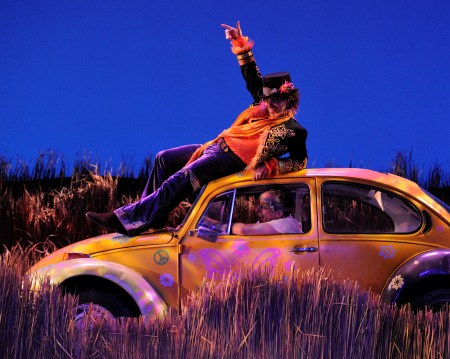
(Eduardo Placer as Puck rides the flowery VW)

For those of us who lived through the 1960s, the decade seems like an ever-appealing amalgam of innocence, drugs, and The Beatles. But for others, it probably just seems like an over-indulged period populated by overly self-centered boomers. That’s why the Great Lakes Theater Festival production of A Midsummer Night’s Dream can feel a bit too familiar and dog-eared.

The problem is not that this company did practically the same show (on the same set) seven years ago, nor is it because the Beatles’ songs don’t fit the dizzy romantic frolics in this light Shakespeare comedy. But once again rolling out the painted VW, the granny glasses and the short skirts just seems a tired attempt at freshening a show that can be plenty zesty all by itself.

Filled with fairies, love potions, and mistakenly mismatched lovers, Midsummer is a lively romp. And some of the right elements are in place here. Kevin Crouch swaggers with attitude as Lysander, who is in love with Hermia (an engaging Gisela Chipe). Dudley Swetland leads his band of rowdy craftsmen with punch and panache, and Aled Davies is just wry enough as Oberon, King of the Fairies.

But there are problems, most of which seem to stem from actors trying too hard to camp it up to please director Charles Fee. The usually reliable David Anthony Smith is an over-the-top caricature of a wacky amateur thespian as Bottom, the weaver who fancies himself a prodigious acting talent. And Eduardo Placer works his role as Puck so hard, channeling the intensity of Jim Morrison into this quick-witted elf, that he turns Puck into more of an OCD drone than an amusing and fun-filled sprite.

Meanwhile, Lina Chambers as Helena and Dane Agostinis as Demetrius never register sharp characters, floating through their scenes rather anonymously.

Even so, this play has suffered worse treatments and emerged victorious, and it does so here. Once the mechanicals take the stage in Act Two and present their play within a play, one can look past the Sgt. Pepper band outfits (yawn) and enjoy the evergreen genius of Shakespeare’s inspired discourse on love and magic.

A Midsummer Night’s Dream

Through May 15 at the Great Lakes

Theater Festival, Hanna Theater,

2067 E. 14th Street, 216-241-6000

Friday, April 23, 2010

A Soldier’s Tale, Cleveland Play House

(Robert Ellis, center, as the General)

Sometimes, a hearty stew tastes like mush because all the individual flavors have melded together into one incomprehensible blob. Then again, there's zesty fare like A Soldier’s Tale, now part of Fusion Fest at the Cleveland Play House.

Employing a challenging and intriguing composition by Igor Stravinsky, based on a Russian folk tale, a septet from the Cleveland Orchestra conducted by Tito Munoz sets the musical stage. Then, four actors share the Baxter Theater space with dancers from GroundWorks DanceTheater as they fashion a compelling story of a real soldier from World War II, Private Eddie Slovik, who was executed for desertion.

This historic collaboration of three honored local arts institutions is reason enough to see this remarkable production. But there are even more delights in store than superbly rendered music and dance. The libretto written by Kurt Vonnegut is wonderfully playful, featuring an impish use of rhyme, but is also brutal and often profane in places. This is more than appropriate for a wartime scenario that also involves a “ballet with lice” as the dancers and actors, in uniform, itch as they hoof.

Under the direction of Seth Gordon, this engrossing mélange also leverages some interesting and amusing projections, including a WWII pin-up gal and a violin-playing devil (a reference to the original tale of a soldier who loses his soul to the devil in trade for his fiddle).

Justin Tatum is engaging as Slovik, but almost pushes his character’s devil-may-care goofiness a bit too far (after all, Slovik didn't want to die and eventually pleaded for clemency, a fact not conveyed in this piece). Robert Ellis is nicely conflicted as the General and Lindsay Iuen, steams things up as a sexy Red Cross gal.

In the preceding work, Catch and Release by Esa-Pekka Salonen, the dancers (Amy Miller, Felise Bagley, Kelly Brunk, Damien Highfield and Sarah Perrett) perform to music that in many ways echoes Stravinsky’s piece. Ranging from lighthearted—there are faint flickers of Gershwin now and then—to more somber, this 20-minute composition is accompanied by lighting effects and videos thrown onto the dance floor.

As the only American soldier to be executed by the U.S. military since the Civil War, Slovik has been condemned for cowardice by some and honored for his courage by others. And so goes humanity’s eternal struggle with just one of the many horrors of war.

A Soldier’s Tale

Through April 25 as part of Fusion Fest,

at the Cleveland Play House,

8500 Euclid Avenue, 216-795-7000

Sunday, April 18, 2010

Eat (It’s not about food.), Fairmount Performing Arts Conservatory

(From left, Alexis Floyd, Doug Kusak and Nina Domingue)

In theater, as in life, the road to hell is sometimes paved with good intentions. And to be honest, the good intentions at work in this 70-minute play are profound and deeply felt. But the resulting production is about as subtle as taking a shovel to the back of the head, and roughly as entertaining.

Penned by Linda Daugherty, and performed by about a dozen young people, along with a handful of adult actors (some of whom have distinguished performing credentials), Eat, now being produced by the Fairmount Performing Arts Conservatory, is an indigestible lump of statistics, lecturing and half-hearted storytelling. And that’s too bad, because the subject of eating disorders is certainly important and deserves a better treatment.

Drenched with earnestness, Daugherty’s script often sounds like bullet points about anorexia and bulimia gleaned from Wikipedia. In a series of fragmented scenes, kids and adults act out a couple poignant moments (Juliette Regnier as a crippled ex-ballet dancer is one). But mostly, these are curiously isolated glimpses from the lives of those beset by eating disorders, along with their underlying psychological issues such as anger, low self esteem, etc.

All the actors play multiple roles, with so many multiples in play that it’s hard to ever develop a bond with any of them. The one exception is Amy, a teenager who is first complimented by her friends for her sleek figure, but who then spirals down. Alexis Floyd does what she can with this barely two-dimensional character, while Nina Domingue and Doug Kusak seem at sea as her woefully underwritten parents.

There isn’t sufficient character development or dramatic tension to sustain even a production this short. And that disconnect lessens the impact when sad or tragic things happen. This problem was exacerbated on opening night by some technical glitches (music drowning out dialogue, other recorded inserts too faint to hear) caused by a computer malfunction.

This well-meaning production, directed by Fred Sternfeld, is sponsored by several medical centers involved in treating eating disorders. And one hopes that those who attend will gain insights from some of the facts in the show, as well as from the talk-backs scheduled after each performance.

But solely viewed as theatrical fare, this dish needs to be sent back to the kitchen.

Eat (It’s not about food.)

Through May 2, produced by the Fairmount

Performing Arts Conservatory, at the Mayfield

Village Civic Center, corner of SOM Center

and Wilson Mills Blvd, Mayfield Village