Monday, September 20, 2010

Closure, Karamu House

(Shambrion Treadwell)

A single line from this production sums up the trauma of losing one’s home to the ravenous forces of our financial meltdown: “Foreclosure papers shredded, left on the lawn.” You can feel the frustration and anger that throbs in those few words.

That is just one of many telling thoughts in Closure by Mary Weems, now at Karamu House. This collection of poems—performed alongside and weaved into snatches of music, dance, singing and yodeling (!)—is an intriguing production. Most of the short poems are written in the voices of a variety of inanimate objects, the things that people leave behind when forced to abandon their homes.

This is a challenging format to sustain, since there are no characters to follow and no way to build tension. But under the direction of Terrence Spivey, aided by fluid choreography by Dianne McIntyre and evocative photographs by R.A. Washington, the 80-minute performance (with an essentially unnecessary intermission) manages to sustain interest for much of the time.

Plenty of objects have thoughts they want to share, including a drawer, a hairbrush, a light bulb, a hallway, and many more. Since the poems are fairly brief, these snapshot observations go down easily. On the flip side, the bite-sized bits (there are 27 of them) begin to get repetitive and you start to long for some interaction with the real people who were affected.

The six-person ensemble includes Rodney Freeman, Cameron Dashiell, Amanda Lanier, Saidah Mitchell, Shambrion Treadwell and Kyle Carthens. Each has featured moments and they all perform seamlessly as a group, lending the evening a sense of unity the material itself doesn’t supply.

Ultimately, the clever premise devours itself, since objects can’t grow, change or rage against these sad situations. And that drains a lot of passion from the proceedings. Still, the production is often enthralling, lovely to look at, and even quite amusing. And that ain’t half bad.

Closure

Through October 10 at Karamu House,

2355 East 89th Street, 216-795-7077

Friday, September 17, 2010

Altar Boyz, True North at French Creek

(The Boyz from left: Colin Bigley, Matthew Ryan Thompson, Josh Rhett Noble, Eric Fancher, and Alex Arroyo)

Even though the whole “make a word plural with a z” thing is totally played, the up-beat musical Altar Boyz, now being produced by True North at French Creek, can still generate a lot of grinz. This tuneful romp about five diverse young dudes in a Christian rock band oozes with charm, mixing sincere God talk with enough wry asides and winks so that even agnostics and atheists in the audience can find a foothold.

The music and lyrics by Gary Adler and Michael Patrick Walker dominate, since the whole show is presented as a concert in progress. The differentiating gimmick is that there’s a computerized, glowing cross that shows how many audience souls have been saved from the clutches of Satan. If you feel a cringe coming on, relax. It’s all executed with boyish verve and none of the fundamentalist fervor that can get downright scary.

Four of the five chaps are named Matthew, Mark, Luke and Juan (you’ll never guess, he’s Hispanic!). And they are joined by Abraham, a wandering Jew who stumbles upon the group and is taken in because he knows how to write lyrics. These personalities, as written by book author Kevin Del Aguila, are one-dimensional, and it’s up to the performers to shake that shallowness and make these guys come alive. In this task, the True North cast is only partly successful.

The group is led by the (supposedly) pure-of-spirit Matthew, played by Josh Rhett Noble who is reprising a role he played at Beck Center a couple years ago. Noble sings well in a gentle, lyrical way—his “Something About You” solo is a tender highlight—and he establishes a firm center for the other players. Matthew Ryan Thompson makes the most of Mark, a juicy role since he’s the token gay boy who’s smitten with a non-comprehending Matthew. Thompson is always on point with his characterization, and he gives his star turn, double-meaning song “Epiphany” a rockin’ good feeling.

As Juan, Alex Arroyo starts off a bit heavy handed, making too much of the guttural “j” sounds as he teeters on caricature. But he gradually loosens up and turns an emotional event in the second act into a surprisingly affecting moment.

Eric Fancher plays Luke, the “bad boy,” but he never takes enough risks and one never senses the real rough side of this potentially interesting character. Luke should be generating constant friction with the other “do-gooders,” but that tension never develops. And Colin Bigley is largely transparent as Abraham, failing to find a through line for his character. Since he is a linchpin in the play’s climax, where the boys face a tough decision, this concluding moment fails to resonate.

Although the individual performances vary in quality, the boys are sharp when doing their group numbers. The voices blend pleasingly and they execute director/choreographer Sarah Clare’s often inventive dance moves with energy and precision. They are supported in fine fashion by music director Jordan Cooper’s tight four-member band.

Performed in a spacious theater/gallery in a handsome nature center facility, this show wears it’s belief openly and proudly. And it’s often quite a blast, even if you are a heathen.

Altar Boyz

Produced by True North Cultural Arts

at the French Creek Nature Center,

4530 Colorado Ave., Sheffield Village,

440-949-5200

Saturday, September 4, 2010

Say You Love Satan, convergence-continuum

(Lukas Roberts as Jack and Scott Gorbach as Andrew)

If falling for a “bad boy” is compellingly attractive to many women and gay men, then being swept away by the son of Satan himself would have to qualify as the ultimate hard-on. Especially if that hellacious offspring was hot, smart, and able to chill a bottle of beer with a wave of his hand.

This is the situation that forms the core of Say You Love Satan by Roberto Aguirre-Sacassa, now at convergence-continuum. And while the play revolves around a contemporary incarnation of beelzebub, it never comes to grip in any significant way with a number of heavy issues raised on the periphery. Instead, the focus here is on laughs, and the con-con crew delivers plenty of those thanks to fine performances and deft timing.

Andrew is a kind of nebbishy gay guy who is between relationships (with nice Jarrod and egomaniacal Chad), and re-reading The Brothers Karamozov in a laundromat. In steps Jack, who proceeds to strip to the waist and starts doing pushups while waiting for his clothes to cycle. Andrew is instantly smitten by Jack’s other-worldly gorgeousness, and soon they are spending the evenings together.

This new relationship shunts wonderful Jarrod (he volunteers at an orphanage where he holds babies that have been neglected) off to the side. But Andrew is a bit bothered by Jack’s “666” tattoo in his hairline, and his difficulty in walking when the sun’s about to rise.

As Andrew and Jack grow closer, things heat up in unforeseen ways and Andrew’s gal pal Bernadette is called upon to help save her buddy from the fires of the damned. And further assistance comes winging in from a most unexpected source.

The playwright sprinkles plenty of punch lines throughout the script (Jack: “Are you Russian?” Andrew: “No, I’m just sullen.”), and even when the gags are predictable, they manage to click. This is due in large part to Scott Gorbach, who invests Andrew with just enough earnest naivete to make his character endearing and relatable. For instance, Andrew insists on keeping his eyes open during a kiss, which becomes hilarious during his frequent lip-locks with Jack.

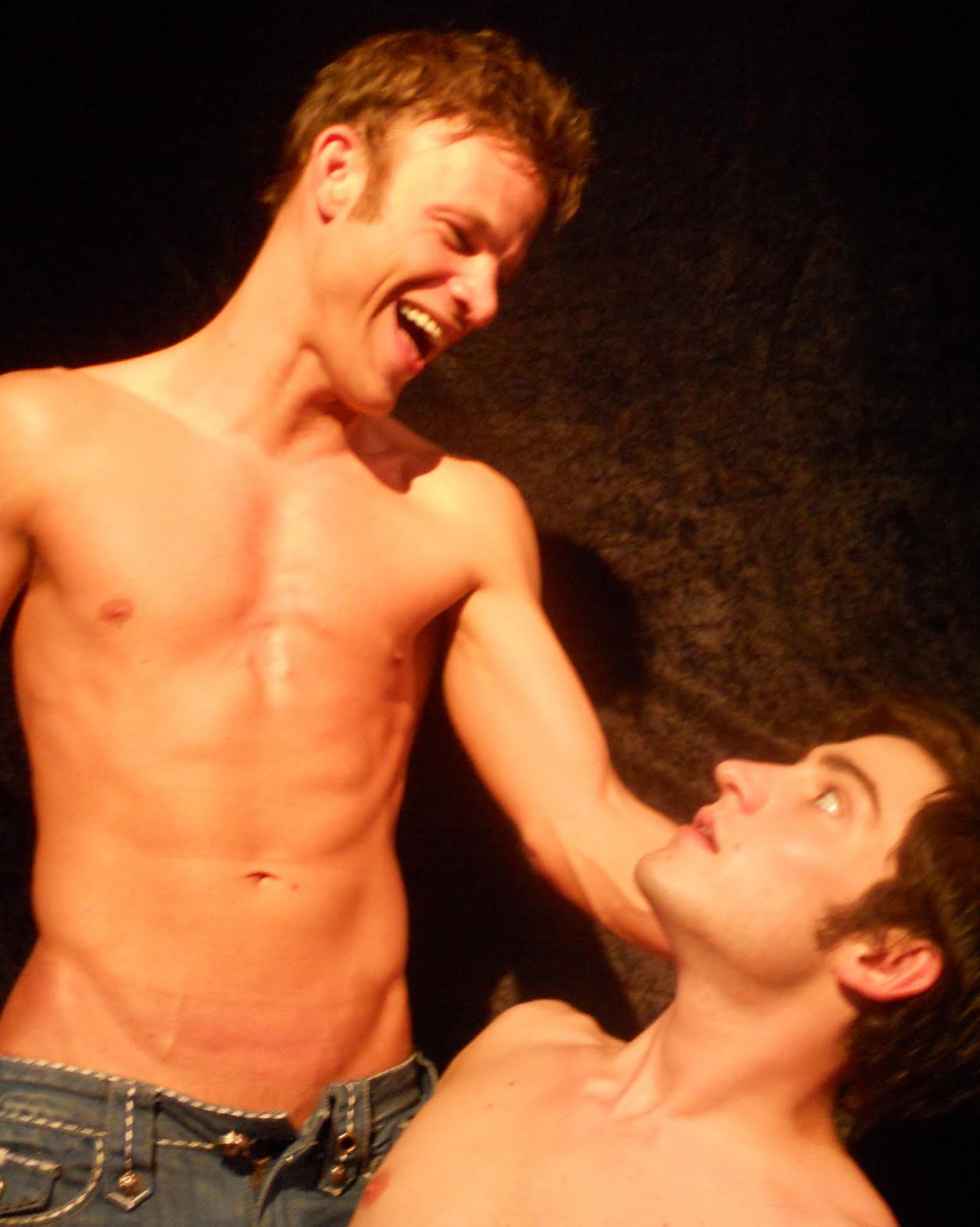
As Jack, Lukas Roberts has a sizzling bod and a matching manner that will steam your glasses (and if you don't wear specs, he'll fog up your corneas). He’s a passionate, sexy handful, and when his amorous smoldering turns into flames of anger, you can feel the raging heat. Ultimately, when Jack’s real identity is revealed, Roberts has the acting chops to make it feel real.

Zac Hudak, double cast as the preening Chad and surprise visitor Raphael, is spot-on in both roles, while Stuart Hoffman is wistfully charming as angelic Jarrod. Lauren B. Smith garners a number of laughs as the put upon Bernadette, although her high decibel rants become a bit wearying.

The script works hard to develop a thematic connection between the patricide-centered plot of the Dostoyevsky novel that Andrew lugs around and Jack’s supposed conflict with his dad, but this juxtaposition never quite jells. This makes Andrew’s frequent mini-lectures on The Brothers Karamozov a bit of a bore.

And ironically, for a play that makes fun of Disney musicals (Jack admits there’s a special place in Hell for people in those productions), Aguirre-Sacassa tacks on a pat, smiley-face ending that doesn’t really feel true to the characters he’s created. Indeed, it’s a conclusion the Disney studios might have dreamt up.

Director Clyde Simon once again reshapes his small playing area to maximum effect, and keeps the pace brisk and amusing. However, con-con's obsession with using video in all their plays is once again a loser, as the video segments are either unnecessary (people dancing in a bar while live actors dance in a bar) or tedious (watching Jack and Andrew exit a car and walk across a street, watching laundry tumble).

Still, there are giggles aplenty in this piece. And that makes it easy for anyone to love this particular six-packed, stone cold sexy Satan.

Say You Love Satan

Through September 25, produced by convergence-

continuum at The Liminis, 2438 Scranton Road,

216-687-0074

Friday, July 30, 2010

Song of the Seekers, Cleveland Public Theatre’s Student Theatre Enrichment Program (STEP)

STEP right up, ladies and gentlemen, boys and girls, and stop by a Cleveland city park for a galvanizing performance of Song of the Seekers by 27 talented teenagers. Working with director Chris Seibert and other Cleveland Public Theatre teaching artists, these students have adapted an ancient Indian text and made it compelling and contemporary.

This is free family theater, presented by the students in CPT’s STEP Program, and their hard work has culminated in an entertaining hour-long show. Employing a variety of musical formats from beat boxing to “Diamonds Are A Girl’s Best Friend,” the show follows a group of poets and a troupe of entertainers as they merge, flare up against each other, and eventually explore what it means to be an artist as well as an individual of worth.

This large cast has a lot on its plate, but it handles the often stylized movement with the energy and precision this kind of presentation requires. Plus, the actors enunciate clearly so that very few words are lost, even when nearby trains or trucks rumble past (one of the challenges of open-air productions).

Among the Poets, David Lewis Jr. as Ares and Michael McNairy as Leachim handle most of the heavy lifting as the story unspools, and soon we are introduced to Christopher Dooms as the arrogant and charismatic King Palaka (or “King P,” as he prefers). The King’s singers and dancers, dubbed KPEC for King Palaka’s Entertainment Company, have a new star, the beautiful Vasa, played with a nice mix of strength and vulnerability by Janette Patterson.

Trouble is, there are two guys with their eyes on Vasa: the poet Charudat (an engaging Dionte Sawyer) and the King’s bro Roofis (Marcus Howard in an amusingly boastful performance). Charudat is shadowed by his best friend Maitreya, rendered with comical goofiness (and irrepressible hunger) by Malcolm Keenon.

Amongst the songs and dances, other performers make themselves known. Isaiah Cancel is loose and limber as the gambler Lewie, who can predict the future with his dice, and Shalese Thornton exhibits excellent concentration, never breaking character as she sings and cavorts as a “court jester.”

Biana Carr is effective as Vasa’s best friend Sookie, and Bianca Carr registers the right amount of authority as Vasa’s mother Yaya. Kalim Hill skulks with the best of them as the thief Bartimus and Chatiana Moore is a powerful presence as Shanda, Charudat’s sister.

The rest of the exciting company includes Jocelyn Newkirt, Brianna Larkins, Jawan Rustin, Sean Eafford, Darryle Barnes, Olivia Winsteard, Nate Woodland, Dawon Taylor, Matthew McNeal, Tyisha George, Jasmine Harris, Christian McGinnis, Essence Flores and Syeed Selmon.

These performances are free and easily accessible, so stop by, bring a blanket or lawn chair, and see what an outstanding group of young people have been doing with their summer. You’ll be delighted!

Song of the Seekers

Produced by the CPT STEP Program.

Through August 8, free, at local parks.

Visit here for the schedule and locations.

Friday, July 23, 2010

Oh Dad, Poor Dad, Mamma’s Hung You in the Closet and I’m Feeling so Sad, CSU Summer Stages

(Eric Perusek as Jonathan and Everett Quinton as Madame Rosepettle)

First of all, no, the title isn’t a metaphor. It’s actually one of the strange things that happen, quite literally, in Arthur Kopit’s psycho-absurdist farce. First performed about 50 years ago, this play is a parody of Freudian psychology and all its extenuating effects on sex, family and relationships. And this production at CSU Summer Stages, although overcooked in parts, triggers much of this work’s dark comedy that still retains its punch.

The domineering and despicable Madame Rosepettle is traveling through the Caribbean with her neurotic, stuttering and barely functional grown son Jonathan in tow. She constantly refers to him using one of her dead husband’s several names while dad himself is never far away—stuffed and hanging in the closet when he isn’t tucked into his traveling coffin.

By keeping sonny under lock and key, and then allowing him some restricted face time with the mysterious and sensuous Rosalie, mommy attempts to protect Jonathan from the evil world—inside her head. Seeking companionship of her own, she wines and dines Commodore Roseabove, an older gentleman who is first smitten and then repulsed as Madame reveals herself.

As Rosepettle, Everett Quinton handles his cross-gender task with teeth-clenching intensity. This approach feels a bit over-torqued in the first act, as mom and boy set up housekeeping with her vicious menagerie: a piranha and two Venus flytraps, each played by actors. Similarly, Eric Perusek as Jonathan is working his Aspergers-like mannerisms so hard early on that we can’t glimpse the character underneath.

However, both performers ease up a little in the second act and the gears of the farce start to engage. Rosepettle’s scene with Roseabove, works exceptionally well, thanks to Quinton’s hypnotically malevolent monolog about Madame’s first hubby, and George Roth, who gives the Commodore a sweet innocence that wilts under Rosepettle’s onslaught.

Perusek feels much more genuinely vulnerable in the second act as he reaches a climax (not the kind you might expect) with Rosalie. As Rosalie, Jillian Bumpas plays it all a bit too straight, not allowing us to see any of this woman’s shadows until her last scene.

Director Scott Spence keeps the pace brisk (helpful, since the play is overwritten in parts) and uses a clever playlist of florid tunes (Bolero, all during the intermission) to highlight the weird unreality of these goings-on. If you’re in the mood for some good old 1960’s style absurdist fun, this might just be your ticket.

Oh Dad, Poor Dad, Mamma’s Hung You in the Closet and I’m Feeling so Sad

July 30 and August 6, CSU Summer Stages,

CSU Factory Theatre, Chester Ave. and E. 23 St.,

216-687-2109

Monday, July 19, 2010

Hunter Gatherers, convergence-continuum

(From left: Lauren B. Smith, Geoffrey Hoffman, and Tom Kondilas)

There’s a paper-thin veneer that separates us civilized folks from the more base and primitive selves that lurk just below the surface. Don’t believe it? Just have the power grid go down for a couple weeks and see how you and your neighbors start behaving.

In Hunter Gatherers by Peter Sinn Nachtrieb, now being staged by convergence-continuum, the playwright throws two couples together at their annual wedding anniversary dinner. And it quickly turns into a raucously funny, highly sexualized farce that's played with loopily unhinged brio by the con-con cast.

Richard & Pam and Tom & Wendy shared a double wedding some years ago and now, in their mid-30s, they pursue apparently conventional urban lifestyles. Except that, from the first moment of the play at Richard and Pam's home, we realize the civilizing veneer has been lifted. Richard has brought home a live lamb, which remains unseen in a tall box, and proceeds to slit the animal’s throat so he can turn it into an entree.

From that point on, all bets are off as we are presented these characters’ true natures without any of the usual filtering. Wendy arrives by herself, since her physician husband is searching for a parking space, and we know within moments that their marriage is kaput, sexually and in every other way. Indeed, Wendy is hot for Richard and quickly tries to maneuver herself into his clutches.

Once Tom arrives, Richard wrestles him to the ground, symbolically pissing on him to claim his turf. And so it goes, abetted by the playwright’s clever and incisive dialog, until there is more than just psychological carnage, and a surprising survivor stumbles away to live another day in the jungle we call life.

The performances are both broad and subtle, and are divided evenly among the cast. On the broad side, Geoffrey Hoffman makes Richard a hyper-masculine stud-on-steroids, ready to fuck, kill or cook anything in sight. A putative artist, he soon decides his real art centers on crotch-related activities. Laurel Johnson’s Wendy is his female equivalent, swinging from manic highs to desperate lows, and only seeking to pork Richard at the first opportunity.

Those two hunters are married, as luck would have it, to a couple gatherers. As Tom, Tom Kondilas is sensible and restrained until a bedroom scene with Pam unleashes his submissive side, with unfortunate consequences. And Lauren B. Smith simmers effectively as Pam until all hell breaks loose in the second act.

Directed by Clyde Simon, Hunter Gatherers challenges our view of civilized behavior while making us laugh at our own artificial social constructs. And you leave the theater musing on how little it might take for any of us to be reduced to our more primitive instincts.

Hunter Gatherers

Through August 14, produced by convergence-continuum

at The Liminis, 2438 Scranton Road, 216-687-0074

Saturday, July 17, 2010

The Elephant Man, CSU Summer Stages

(From left: Eric Perusek as Merrick, Geoff Knox as Treves, and Ursula Cataan as Mrs. Kendall)

In a perfect world, our external appearance would be shaped by the goodness we have inside. That would make it a lot easier to spot the real monsters in our midst. But then, who’s to decide what “goodness” is; Tea Partiers and devotees of Daily Kos might disagree mightily.

In a similar way, there are many layers at work in The Elephant Man by Bernard Pomerance, now at CSU Summer Stages. This is the story of John (real name Joseph) Merrick, a man burdened with morbid physical deformities but possessing a gentle and intelligent mind. And this CSU production under the direction of Everett Quinton gets virtually everything right, fashioning a drama that raises questions both simple and profound.

We first meet Merrick in the 1880s as a sideshow freak, and that’s where Dr. Frederick Treves finds him and takes the confused, misshapen man into his care at the London Hospital. Few can access Merrick’s beautiful side since his handicap prevents him from speaking clearly, and few would even have the nerve to come close enough to hear him.

Stage directions indicate that Merrick is to be played without elaborate makeup, as was done in the movie version, so the task of conveying Merrick’s extreme physical distress is left to the actor. Eric Perusek does an admirable job of contorting his body and face, allowing Merrick’s enormous and weighty head (it was ballooned out by bony growths and fleshy sacs) to loll to one side, then struggling to bring it upright again. Although these contortions aren’t entirely consistent throughout the play, Perusek does a splendid job of crafting a flawed yet empathetic character.

He is well supported by Geoff Knox, who plays Treves with a polished air of self-entitlement, a young physician on the make who has stumbled on a grotesque medical treasure. But his adherence to Victorian rules and behaviors are assailed, and Knox deftly reveals the conflicts besetting Treves.

In order to help humanize Merrick, Treves introduces Merrick to the beauteous actress Mrs. Kendall (a pitch-perfect and riveting Ursula Cataan). After perusing photos of the naked Merrick provided by the doc, she first notices that Merrick’s junk is in fine shape. And later, she shares a glimpse of some of her secondary sexual characteristics, much to Merrick’s delight and Treves’ outrage. Also excellent are Tom Woodward as the sideshow manager Ross, Derek Davidson as the Bishop, and George Roth as Carr Gomm, the head of the hospital.

Although there are a couple small glitches—the supposed moronic trio of pinheads seem more like three gals in a ladies golf league costumed for an outing—the tone of the production is strong and consistent. This is aided by the moody, between-scenes cello music performed by Maake Harding.

As Merrick insinuates himself into society, being gifted and visited by the upper crust, we see hypocrites and celebrity suck-ups for what they are. And it makes us wonder about how we perceive beauty and the real value of other human beings. That’s a lot for any play to deliver, and this CSU Summer Stages production does it with well-modulated passion.

The Elephant Man

Through August 15 at CSU Summer Stages,

CSU Factory Theatre, corner of Chester and E. 23 St.,

216-687-2109