Thursday, October 28, 2010

An Orchard, Cleveland Play House/Case Western Reserve University

(Kelli Ruttle as Ranyevskaya and Eva Gil as Varya)

If people were like trees, we’d never forget a single thing. That is a beauty of nature: no matter the storms it endures, it continually replicates itself in every detail, even as it grows. Meanwhile, humans are destined to get older and bigger but misremember important occurrences from the past, be tortured by others, and just flat out forget still more. From that standpoint, compared to nature we’re not even qualified to be a respectable weed.

In The Cherry Orchard, Anton Chekhov marries those thoughts in, what for him, was a comical play verging on farce. It’s the story of an aristocratic but now penniless Russian family whose vast estate, with its fabulous orchard of cherry trees, will be auctioned off to pay their debts. While being stabbed with piercing moments of clarity about their pasts, and the hurts that reside there, they must deal with the present—and with glorious natural surroundings that seem to mock their meager attempts at coping.

In a modest bow to the many interpretations of this play, this Cleveland Play House production in association with Case Western Reserve University is simply called An Orchard. As it turns out, that is apt since the shortened title is mirrored by the fact that the number of characters has been substantially pruned, while also trimming some of the emotional wallop that this story can generate.

Director Mark Alan Gordon, who compiled the adaptation along with the graduate ensemble of 2012, helps his cast find much of the humor in Chekhov’s words. But the young actors miss a number of the nuances that should lift this tale above the ordinary.

When Lubov Andreyenva Ranyevskaya, nicknamed Lovey, returns to her family’s estate, along with her brother Gaev and her grown daughter Anya, the atmosphere is bittersweet. Gathering in the child’s nursery, a memory-inducing setting if there ever was one, Lovey is confronted with the ugly current reality by Lopakhin, a merchant who formerly worked as a servant on the grounds of the estate. He urges Lovey to divide the estate into small parcels, to sell as plots for vacation homes.

But Lovey is a woman caught between forces she doesn’t understand. Spending freely and irresponsibly has been her way of life, and now that change has arrived she can’t bend with the wind. As a result she, her family and friends, and even servants are ripe for destruction.

In the complex role of Ranyevskaya, Kelli Ruttle hits a variety of separate notes with great style, and her rendition of "When the World Was Young" at the start of Act Two is affecting. But there isn’t enough subtext to convey this woman’s full and often contrary persona. Flamboyant and haunted, generous and controlling, Lovey is really a piece of work, which is only glimpsed here in part.

As Lopakhin, Dan Hendrock has energy to burn as this driven and aspiring man. And his delivery feels a bit stilted and considered, as it would for a man who feels somewhat out of his element. But in his climactic scene, when he announces his purchase of the estate, there is joy and amazement but not enough anger borne of his rage at his humble history in that place.

Andrew Gorell, in the role of Gaev, enjoyably trumpets his wordy flourishes, but he doesn’t quite capture the childish arrogance of a man who has never fully grown up. Michael Herbert essays the “eternal student” Trofimov with a rumpled sort of idealism, and the adopted daughter/estate manager Varya is played by Eva Gil with repressed anger. But she could do more with the moment when she throws her house keys down in disgust, before she is about to be thrown out the door. Yan Tual triggers some chuckles as Firs, the nearly deaf manservant, but his shuffling old man schtick, although a nice homage to Tim Conway, gets a little tired.

At first glance, the set design by Jill Davis is stunning, with audience seating arranged in a circle, in a tall space draped with heavy curtains and lighted with chandeliers. There are also several birch tree trunks that extend from floor to ceiling, bringing the essence of nature into these living quarters.

Upon reflection, however, the set is less appealing since it does not suggest a nursery in any significant way. And the trees, while amazing to look at, seem firm and stalwart—just the opposite of cherry blossoms that are fragile and easily destroyed, which is part of the playwright’s central metaphor.

An Orchard is just that, one more take on The Cherry Orchard that is delightful in places, but that feels a bit too condensed to be thoroughly satisfying.

An Orchard

Through November 6 at the Cleveland Play House,

produced in association with Case Western Reserve

University, 8500 Euclid Avenue, 216-795-7000

Tuesday, October 19, 2010

Kill Will, Cleveland Public Theatre

(Josh Brown and Kelly Elliott)

Chances are, if you brought a Shakespeare devotee together with a young person hooked on movies such as Slaughtered Vomit Dolls and Ilsa: She Wolf of the SS, the conversation might not go swimmingly. But oddly enough, they each occupy common ground in their entertainment passions when it comes to one thing: violence.

It's no news that there is ample gore in the works of The Bard, and those skewerings, beheadings and poisonings are the sum total of what appears in Kill Will, directed by Alison Garrigan, now at the Cleveland Public Theatre.

Show creators and sole performers Josh Brown and Kelly Elliott gather some of the more gruesome moments from Shakespeare’s plays, spin them with a froth of contemporary cultural references, and then act them out using their talents as fight choreographers. The hour-long result, depending how you look at it, is either a very amusing gym class or a less than absorbing but mildly entertaining theatrical event.

With a video screen announcing the plays from which bloody scenes are lifted, Brown and Elliott toss each other onto the (padded) floor, bounce their faces off walls and columns, and generally create mayhem. As they abuse each other, they work in modern allusions to movies such as Star Wars and self-defense equipment (Desdemona brandishes pepper spray).

Some of the bits are inspired, such as a video game sequence with Macbeth done as Mortal Kombat as we watch the game characters on the screen do each other in, complete with spurting blood. And Titus Andronicus is awash in sparkly red plasma.

Other scenes are yawners, including a battle with poles, “armed” with pillows on each end, which turns out to be about as fearsome as it sounds. And an attempt to do Richard III with stuffed animals is promising until it becomes clear there is no further wit at work other than the concept itself.

Actually, the script for Kill Will has a number of clever, inside references to Shakespeare and his works. But it could use more of those, which could hlep this piece rise, more often than it does, above a silly sort of calisthenics.

As you might imagine, the show also includes audience participation. But clench not thy teeth: it actually works. Indeed, on this night a couple things the audience members improvised to portray Shakespearean suicides were funnier than what the performers thought up.

The actors themselves (who are married to each other) are an odd fit. Brown has an agreeable affect, with a sly smile never far away, that makes him easy to like. But Elliott relies too much on yelling for projection, and on a grimace for facial expression. It’s not clear if she’s supposed to be the “bad guy” or she just comes across that way. In any case, the combination feels slightly off-center. There is also a subtle marital subtext to all of this, but it doesn't work and just gets in the way.

Anyhow, if you’re in the mood for a non-demanding evening, with tons of non-violent violence, then Kill Will should do the trick.

Kill Will

Through October 30 at Cleveland Public Theatre,

6415 Detroit Avenue, 216-631-2727

Thursday, October 14, 2010

Don’t Call Me Fat, Cleveland Public Theatre

(From left: Lissy Gulick, Kevin S. Charnas, and Lew Wallace)

First, let’s get one thing straight. I am not capable in any way of attempting to write a satire of Turkish culture, in their language, and have it ring true to people in Ankara. Hell, I couldn’t even get one sentence written. So I stand in awed respect for anyone who can try to accomplish a similar daunting task.

That said, the issue around Don’t Call Me Fat, a play by visiting Turkish playwright Ozen Yula now receiving its world premiere at Cleveland Public Theatre, is whether this send-up of America’s gluttonous ways works. And sadly, it doesn’t. Sure, it’s excessively long, but the problem isn’t that the play is wordy. It’s that the words consistently fail to amuse, entertain, or enlighten.

Oh, there are some momentary shocks, to be sure. Since the morbidly obese John Doe (really? John Doe?) spends all his first act time in a hospital bed, his crazy relative Jane Doe (Lissy Gulick) blisters him with a litany of f-bombs and fat-boy insults. And those can generate some nervous laughter, simply from their frontal outrageousness.

But obesity is a subject that’s been chewed over in the U.S. damn near constantly for many decades, and it’s hard to find a new way to satirize it. Playwright and director Yula attempts this in part by giving John (Kevin S. Charnas) an invisible friend—a young woman, Joanne (Faye Hargate), dressed as a Playboy bunny on a swing above him. Joanne is prone to drift off into little stories that delight corpulent John but which are less than enthralling for the audience. There are also predictable parodies of the "helping" professions such as psychologists and physicians.

Many of the jumbled references in the play seem as dated as the Playboy bunny riff. In the second act, John has been magically transformed into a lean stud, and a craven TV producer (Lew Wallace) is trying to make buff John the hot new folk hero in America. Problem is, the play tries to do this by lampooning a clunky TV show style that went out with This Is Your Life more than 50 years ago, bringing on guests from John’s past including his drunken and deluded mother. Clumsy and nearly unintelligible video clips, which are half-obscured by the set, don't help. Neither does the shaggy dog ending.

There are multiple elements in this show that might, conceivably, work together given some rigorous editing and rewriting. But the playwright is heading back to Turkey soon, so that seems unlikely.

Word has it that Yula’s visit has been edifying for those who have interacted with him. Let’s hope that is true, because the seven on-stage cast members give their all for his play. But the flabby Don’t Call Me Fat is suffering from advanced theatrical arteriosclerosis, and the prognosis isn’t promising.

Don’t Call Me Fat

Through October 30 at the Cleveland

Public Theatre, 6415 Detroit Avenue,

216-631-2727

Monday, September 27, 2010

An Ideal Husband, Lakeland Civic Theatre

( Katherine DeBoer as Mabel and Diane Mull as Lady Chiltern)

If you prefer your Oscar Wilde with a whiff of social relevance, then An Ideal Husband might be your cup of tea. It deals with an instance of political intrigue that ignites a blackmail plot, which is a lot of heavy lifting for a playwright whose wealthy characters usually just indulge in trivial and insanely witty banter while munching cucumber sandwiches.

And if this is your kind of play, you have two chances to see it. The Great Lakes Theater Festival opens their version on Saturday, October 2, and the Lakeland Civic Theatre’s production is up and running now. While the Lakeland effort struggles to find its pace in the rather lengthy first act, things perk up after intermission and a Wildean good time is had by (almost) all.

Sir Robert Chiltern, an apparent paragon of virtue, is waylaid at a party by Mrs. Cheveley, a snarky woman who knows a secret in Chiltern’s past. It seems Chiltern sold a state secret for the money that continues to finance his luxurious lifestyle. For her own financial reasons, she forces Chiltern to reverse his negative report on the Suez Canal, lest she release the proof of his previous indiscretion.

Meanwhile, Chiltern’s best pal, Viscount Goring, goes meandering about as an air-headed dandy, the scourge of his father, the Earl of Caversham (Michael Rogan). Goring has most of the best lines, structured in the familiar tempo Wilde uses. As he observes: “To love oneself is the beginning of a lifelong romance.”

As Chiltern and Cheveley battle it out, Chiltern’s wife (a steely yet loving Diane Mull) stands by her man, until facts, intercede, and Goring tries to woo Chiltern’s lovely sister Mabel.

The Lakeland cast battles to a draw with the first half of the play, as the actors try to find their footing. In the central role of Sir Robert, Jeffery Grover provides a solid presence. But his fencing with Mrs. Cheveley doesn’t spark as it should, because Jennifer Davies, as Cheveley, delivers many of her lines with an unchanging tempo and a single facial expression trapped somewhere between a sneer and a wince. Playing a nasty person should be a lark, but here it seems a chore.

On the other hand, Katherine DeBoer as Mabel is a delight, capturing the frivolous essence of Wilde’s words. In the smaller role of Lady Markby, Maria Thomas Lister also has a fine time with her few speeches, tossing them off with just the right upper-crust attitude.

In the juicy part of Goring, who is really a thinly disguised Wilde, Doug Kusak labors (under a wig as thick as a beaver pelt) to find his character, failing to take enough chances with shape and texture in delivering the clever wordplay. But Kusak comes out of his shell after intermission, cranking up the energy and turning Goring into an impish cad with a heart of gold.

Even though the play, at more than 2 ½ hours, is a good deal longer than it should be, director Martin Friedman keeps everyone on point so that the laughs Wilde is due eventually come through.

An Ideal Husband

Through October 10 at Lakeland Civic Theatre,

Lakeland Community College, 7700 Clocktower Drive,

Kirtland, 440-525-7526

Monday, September 20, 2010

Closure, Karamu House

(Shambrion Treadwell)

A single line from this production sums up the trauma of losing one’s home to the ravenous forces of our financial meltdown: “Foreclosure papers shredded, left on the lawn.” You can feel the frustration and anger that throbs in those few words.

That is just one of many telling thoughts in Closure by Mary Weems, now at Karamu House. This collection of poems—performed alongside and weaved into snatches of music, dance, singing and yodeling (!)—is an intriguing production. Most of the short poems are written in the voices of a variety of inanimate objects, the things that people leave behind when forced to abandon their homes.

This is a challenging format to sustain, since there are no characters to follow and no way to build tension. But under the direction of Terrence Spivey, aided by fluid choreography by Dianne McIntyre and evocative photographs by R.A. Washington, the 80-minute performance (with an essentially unnecessary intermission) manages to sustain interest for much of the time.

Plenty of objects have thoughts they want to share, including a drawer, a hairbrush, a light bulb, a hallway, and many more. Since the poems are fairly brief, these snapshot observations go down easily. On the flip side, the bite-sized bits (there are 27 of them) begin to get repetitive and you start to long for some interaction with the real people who were affected.

The six-person ensemble includes Rodney Freeman, Cameron Dashiell, Amanda Lanier, Saidah Mitchell, Shambrion Treadwell and Kyle Carthens. Each has featured moments and they all perform seamlessly as a group, lending the evening a sense of unity the material itself doesn’t supply.

Ultimately, the clever premise devours itself, since objects can’t grow, change or rage against these sad situations. And that drains a lot of passion from the proceedings. Still, the production is often enthralling, lovely to look at, and even quite amusing. And that ain’t half bad.

Closure

Through October 10 at Karamu House,

2355 East 89th Street, 216-795-7077

Friday, September 17, 2010

Altar Boyz, True North at French Creek

(The Boyz from left: Colin Bigley, Matthew Ryan Thompson, Josh Rhett Noble, Eric Fancher, and Alex Arroyo)

Even though the whole “make a word plural with a z” thing is totally played, the up-beat musical Altar Boyz, now being produced by True North at French Creek, can still generate a lot of grinz. This tuneful romp about five diverse young dudes in a Christian rock band oozes with charm, mixing sincere God talk with enough wry asides and winks so that even agnostics and atheists in the audience can find a foothold.

The music and lyrics by Gary Adler and Michael Patrick Walker dominate, since the whole show is presented as a concert in progress. The differentiating gimmick is that there’s a computerized, glowing cross that shows how many audience souls have been saved from the clutches of Satan. If you feel a cringe coming on, relax. It’s all executed with boyish verve and none of the fundamentalist fervor that can get downright scary.

Four of the five chaps are named Matthew, Mark, Luke and Juan (you’ll never guess, he’s Hispanic!). And they are joined by Abraham, a wandering Jew who stumbles upon the group and is taken in because he knows how to write lyrics. These personalities, as written by book author Kevin Del Aguila, are one-dimensional, and it’s up to the performers to shake that shallowness and make these guys come alive. In this task, the True North cast is only partly successful.

The group is led by the (supposedly) pure-of-spirit Matthew, played by Josh Rhett Noble who is reprising a role he played at Beck Center a couple years ago. Noble sings well in a gentle, lyrical way—his “Something About You” solo is a tender highlight—and he establishes a firm center for the other players. Matthew Ryan Thompson makes the most of Mark, a juicy role since he’s the token gay boy who’s smitten with a non-comprehending Matthew. Thompson is always on point with his characterization, and he gives his star turn, double-meaning song “Epiphany” a rockin’ good feeling.

As Juan, Alex Arroyo starts off a bit heavy handed, making too much of the guttural “j” sounds as he teeters on caricature. But he gradually loosens up and turns an emotional event in the second act into a surprisingly affecting moment.

Eric Fancher plays Luke, the “bad boy,” but he never takes enough risks and one never senses the real rough side of this potentially interesting character. Luke should be generating constant friction with the other “do-gooders,” but that tension never develops. And Colin Bigley is largely transparent as Abraham, failing to find a through line for his character. Since he is a linchpin in the play’s climax, where the boys face a tough decision, this concluding moment fails to resonate.

Although the individual performances vary in quality, the boys are sharp when doing their group numbers. The voices blend pleasingly and they execute director/choreographer Sarah Clare’s often inventive dance moves with energy and precision. They are supported in fine fashion by music director Jordan Cooper’s tight four-member band.

Performed in a spacious theater/gallery in a handsome nature center facility, this show wears it’s belief openly and proudly. And it’s often quite a blast, even if you are a heathen.

Altar Boyz

Produced by True North Cultural Arts

at the French Creek Nature Center,

4530 Colorado Ave., Sheffield Village,

440-949-5200

Saturday, September 4, 2010

Say You Love Satan, convergence-continuum

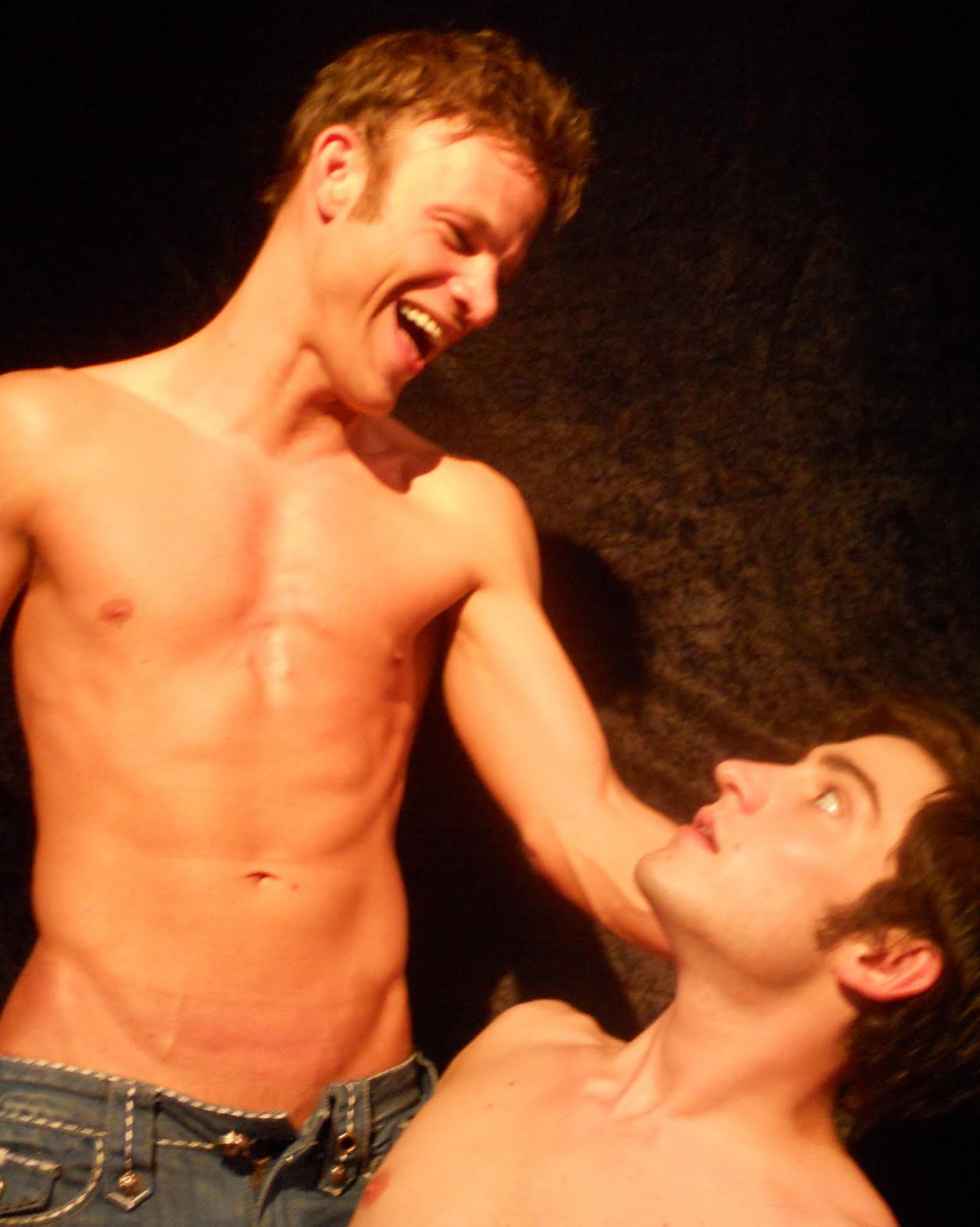
(Lukas Roberts as Jack and Scott Gorbach as Andrew)

If falling for a “bad boy” is compellingly attractive to many women and gay men, then being swept away by the son of Satan himself would have to qualify as the ultimate hard-on. Especially if that hellacious offspring was hot, smart, and able to chill a bottle of beer with a wave of his hand.

This is the situation that forms the core of Say You Love Satan by Roberto Aguirre-Sacassa, now at convergence-continuum. And while the play revolves around a contemporary incarnation of beelzebub, it never comes to grip in any significant way with a number of heavy issues raised on the periphery. Instead, the focus here is on laughs, and the con-con crew delivers plenty of those thanks to fine performances and deft timing.

Andrew is a kind of nebbishy gay guy who is between relationships (with nice Jarrod and egomaniacal Chad), and re-reading The Brothers Karamozov in a laundromat. In steps Jack, who proceeds to strip to the waist and starts doing pushups while waiting for his clothes to cycle. Andrew is instantly smitten by Jack’s other-worldly gorgeousness, and soon they are spending the evenings together.

This new relationship shunts wonderful Jarrod (he volunteers at an orphanage where he holds babies that have been neglected) off to the side. But Andrew is a bit bothered by Jack’s “666” tattoo in his hairline, and his difficulty in walking when the sun’s about to rise.

As Andrew and Jack grow closer, things heat up in unforeseen ways and Andrew’s gal pal Bernadette is called upon to help save her buddy from the fires of the damned. And further assistance comes winging in from a most unexpected source.

The playwright sprinkles plenty of punch lines throughout the script (Jack: “Are you Russian?” Andrew: “No, I’m just sullen.”), and even when the gags are predictable, they manage to click. This is due in large part to Scott Gorbach, who invests Andrew with just enough earnest naivete to make his character endearing and relatable. For instance, Andrew insists on keeping his eyes open during a kiss, which becomes hilarious during his frequent lip-locks with Jack.

As Jack, Lukas Roberts has a sizzling bod and a matching manner that will steam your glasses (and if you don't wear specs, he'll fog up your corneas). He’s a passionate, sexy handful, and when his amorous smoldering turns into flames of anger, you can feel the raging heat. Ultimately, when Jack’s real identity is revealed, Roberts has the acting chops to make it feel real.

Zac Hudak, double cast as the preening Chad and surprise visitor Raphael, is spot-on in both roles, while Stuart Hoffman is wistfully charming as angelic Jarrod. Lauren B. Smith garners a number of laughs as the put upon Bernadette, although her high decibel rants become a bit wearying.

The script works hard to develop a thematic connection between the patricide-centered plot of the Dostoyevsky novel that Andrew lugs around and Jack’s supposed conflict with his dad, but this juxtaposition never quite jells. This makes Andrew’s frequent mini-lectures on The Brothers Karamozov a bit of a bore.

And ironically, for a play that makes fun of Disney musicals (Jack admits there’s a special place in Hell for people in those productions), Aguirre-Sacassa tacks on a pat, smiley-face ending that doesn’t really feel true to the characters he’s created. Indeed, it’s a conclusion the Disney studios might have dreamt up.

Director Clyde Simon once again reshapes his small playing area to maximum effect, and keeps the pace brisk and amusing. However, con-con's obsession with using video in all their plays is once again a loser, as the video segments are either unnecessary (people dancing in a bar while live actors dance in a bar) or tedious (watching Jack and Andrew exit a car and walk across a street, watching laundry tumble).

Still, there are giggles aplenty in this piece. And that makes it easy for anyone to love this particular six-packed, stone cold sexy Satan.

Say You Love Satan

Through September 25, produced by convergence-

continuum at The Liminis, 2438 Scranton Road,

216-687-0074